

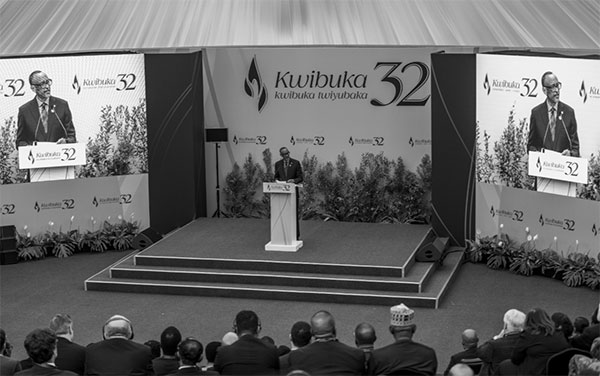
 President Kagame speaks at the 32nd Kwibuka memorial
How a once shattered country has become a beacon of hope for the rest of Africa
THE LAST WORD | ANDREW M. MWENDA | Tuesday, April 7th Rwanda held commemorations marking 32 years since the beginning of the genocide that killed over a million of its Tutsi citizens. It is a genocide where Rwandans turned on each other over fictitious distinctions within their one culture, Tutsi and Hutu. These distinctions existed in precolonial Rwanda but were politicised with toxicity by Belgian colonialists. The consequences of this will continue to haunt Rwanda for decades to come.
However, efforts by the government to contain them are bearing fruits. They involve the reassertion of the shared and common Rwandan identity. The first part has been to inculcate in every person the identity that “I am a Rwandan” (ndi’munyarwanda).
The second goes beyond this to assert prestige in every person: “I have dignity” (ndafite agaciro). To be a Rwandan is to be self-respecting, to see yourself in nobler terms. The third picks from the second and mobilizes people around a shared national vision: “I am rebuilding my country.” Everyone is called upon to contribute to this vision: as taxpayers, as government employees, as members of any community during Umuganda (community work), as businesspersons running private enterprises, as priests shepherding their flock, even as ordinary citizens walking on the street, etc.
Rwanda is far behind Uganda and most especially Kenya in terms of human capital development: the skills and experience to manage and build things. But why does it achieve so much with so little while Uganda and Kenya achieve so little with so much? The answer is identity. As I have stated above, Rwandans have been mobilized to see themselves first as one people, second as special and third as sharing a vision of their future – as individuals and as members of a community. More than skills and pay, it is this identity that makes them achieve so much with so little. So, the policeman on the street wants his/her conduct to reflect his/her identity as special; so does the nurse in a hospital, the cleaner on the street, a civil servant in an office and the teacher in a school.
Words alone cannot bring about reconciliation and a shared vision. Actions do better. The fortunes of the current prime minister of Rwanda, Justin Sengiyumva, epitomise this. He was one of those people who fled to Congo after the 1994 genocide. But RPF, through its policy of reconciliation, returned him to Rwanda in 1996. He became director for internal and external trade and then a permanent secretary in the Ministry of Trade and later Education. Then he fell out with the government, ran into exile and is alleged to have joined both FDLR and RNC. Notwithstanding all this, the RPF convinced him to return home last year. President Paul Kagame first appointed him deputy governor of the central bank of Rwanda in February, and in July he became prime minister.
The lesson one learns from post-genocide Rwanda is that it is very easy to divide people and very difficult to unite them. Dividing people does not require facts but the creation of an imaginary enemy, the other. People will believe this out of fear. It is very difficult to debunk lies because they do not need facts to be believed; they need faith. They are not based on evidence but emotions. And once prejudice has become intuitive, it becomes ever more difficult to remove it from the social consciousness of a people. On the other hand, facts need to be backed with historic evidence and/or statistical data. These take a lot of effort to produce. It is even more difficult for most people to consume and understand such hard stuff.
Look at Israel, a highly educated society with many of its citizens coming from Europe and North America. The demonic and genocidal regime that rules that country has sold tall tales written 3,000 years ago. These Biblical myths claim that the land between the Jordan River and the Mediterranean Sea was given to “Jews” by “God”. On this myth, highly educated and “civilised” people in Israel, the USA and Europe have been complicit in the genocide of Palestinians, natives of that land. When I sit with my Israeli, European and American friends, people who have preached human rights all over the world, I cannot recognize them when it comes to speaking out about what is happening in Gaza.
Now imagine these lies and myths being sold to peasants living a bare existence in the hills of central Africa. Does it surprise anyone that after nearly a century of constant indoctrination Rwanda would descend into genocide? What is surprising, therefore, is not that Rwandans were made to hate each other. That is easy to achieve over one hundred years of indoctrination. What is astounding is that after only 32 years of post-genocide reconciliation, Rwandans now live together in peace and harmony. The Hitlerite prime minister of Israel, Benjamin Netanyahu, once asked Kagame this question. ‘Paul,’ he asked, ‘how did you pull this off?’
The answer in Rwanda has been simple but fundamental: we shall be governed by our hopes, not our fears. We will treat all Rwandans as one and equal people, period.
The victims of genocide, the Tutsi, are the people who wrestled power from the genocidaires. As Kagame has said many times, it is the victims who had something to give – forgiveness. This is a case of power being employed with humility and magnanimity – echoing the words of Winston Churchill: ‘In war, resolution; in defeat, defiance; in victory, magnanimity.’ The powerful are the ones who can give gifts. The Tutsi-led RPF captured power. They have not used it to rule, to dominate and to dictate. They used it to forgive, to share and to reconcile.
Today, the armed forces, the cabinet, the parliament – and many (and in many areas, most) positions of the government are run by people who in 1994 had run to exile, people who have previously fought the RPF-led government. Why? Because under the leadership of Kagame, Rwanda has resisted the temptation that has destroyed Israel – to run the government on fear based on historic grievances. It has made hope, trust, and faith in the goodness of people the cornerstone of its national reconstruction policy.
For this and many other reasons, Kagame, the RPF, or the Rwandan government deserves a Nobel Peace Prize. The fact that the Nobel Committee has never awarded them this prize, despite memoranda submitted to them explaining this, only demonstrates the political and partisan foundations of Western institutions.
***

amwenda@ugindependent.co.ug