

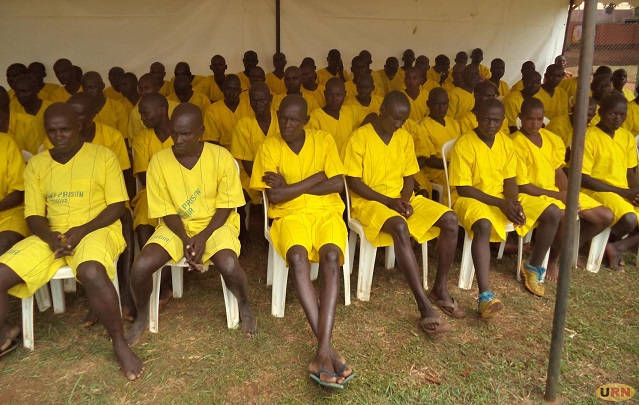
 Inmates attached to Hoima government prison during plea bargaining session at Hoima Magistrates’ court. An inmate collapsed and died at Hoima government prison.
Kampala, Uganda | THE INDEPENDENT | At least 15 out of 280 inmates who sat for the 2025 Primary Leaving Examinations (PLE) from the various Uganda Prisons Service centres (UPS) have passed in the First Grade.
Senior Commissioner of Prisons -SCP Frank Baine, who is also UPS Spokesperson, said that in total they 313 inmates registered for PLE, but 19 did not sit for the exams.
The Prisons Service has explained that Upper Prison Luzira had 61 PLE candidates, Mbarara in Main Prison 40, Mbale Main Prison 23, Soroti Main Prison 23, Moroto 15, Kitalya Mini Max 17, Ndorwa 10, Masaka had nine prisoners, and Gulu had seven.
Other prisons that presented candidates include Nakasongola with seven, Kitalya Farm with eight, Lira Main Prison with six, and Masindi Main Prison with seven candidates.
“Out of these, 280 inmates sat for the examinations, while 19 were absent due to earlier release from custody. The performance was strong across all prison examination centres. 15 candidates attained Division I,” Baine said.
Baine added that 159 candidates attained Division Two, 75 attained Division Three, thirty-one attained Division IV, and 19 candidates were ungraded.
“The Commissioner General of Prisons congratulates all inmates upon their success in the 2025 Primary Leaving Examination,” Baine said.
The PLE results released on Friday show that 730000 candidates passed and qualify to join secondary education. Tis made at least 94% of the 807313 who sat for PLE in 2025
***
URN

