
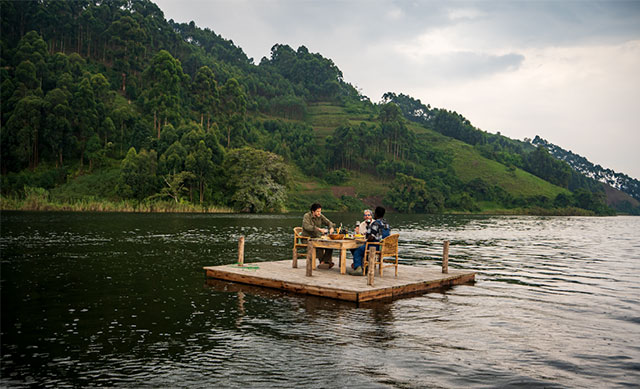
 Guests of Kisoro Art Island enjoy their dinner while taking in the scenery of Lake Mutanda. ALL PHOTOS/COURTESY/KISORO ART ISLAND.
The lake is Uganda’s newest cultural landmark; where art, architecture, and ecology meet the Virunga Mountains
ART FEATURE | RONALD MUSOKE | On the volcanic waters of Lake Mutanda in the southwestern Uganda district of Kisoro, a new cultural geography is quietly taking shape. It does not announce itself with the sterility of a resort brochure or the formality of an institutional museum. Instead, it emerges as something more fluid and ambitious: a living artwork, a hospitality experiment, and a proposition about how culture might rewire the local economies.
Kisoro Art Island, officially launched on March 26, positions itself as a boutique retreat and cultural sanctuary where contemporary art, Afrofuturist architecture, and high-altitude wilderness converge. Framed by the jagged silhouettes of the Virunga Mountains and within reach of UNESCO-protected forests, it is both physically remote and conceptually expansive—an island not only in geography but in imagination.
At its centre is artist Bruno Ruganzu, one of Uganda’s most internationally recognised creative figures, whose practice has long been rooted in ecological repair, material transformation, and community participation. Now, returning to the mountainous terrain of his birth, he is attempting something larger than a personal project.
“While my career has taken me and my art across the globe, I am returning to the mountains of my birth to launch Kisoro Art Island as a catalyst for local upliftment,” Ruganzu says. “I believe art is a universal language that can transform communities; here, we use it to celebrate the Afrofuturist spirit of Uganda.” What emerges from this ambition is not simply a retreat, but a designed ecosystem where hospitality becomes infrastructure for cultural production and art becomes a tool for regional development.
A geography of thresholds
Kisoro Art Island is situated in one of Uganda’s most dramatically layered landscapes. Lake Mutanda, a still body of volcanic water, is encircled by terraced hills and overlooked by the distant cones of the Virunga volcanic chain. Beyond it lie two of East Africa’s most ecologically significant protected areas: the Bwindi Impenetrable Forest and Mgahinga Gorilla National Park.
This proximity is not incidental. The project is deliberately positioned at a threshold between human creativity and some of the oldest surviving ecosystems on the continent. Guests arrive not into isolation, but into a network of ecological and cultural adjacency: forest, water, mountain, village, and artwork all existing within a shared visual and experiential field. The island itself becomes a kind of lens, framing the surrounding wilderness while being continuously shaped by it.
The physical language of Kisoro Art Island is unmistakably rooted in Afrofuturism, but it resists abstraction. Instead, it draws deeply from vernacular form and material heritage. Guest villas are inspired by the calabash; the hollowed gourd traditionally used across East Africa for carrying water and food. Reinterpreted at architectural scale, the calabash becomes both shelter and symbol, an object of sustenance transformed into a vessel for contemporary experience.
Local materials anchor the design in place. Volcanic stone, reeds, and indigenous construction techniques are integrated into the structures, ensuring that the built environment does not dominate the landscape but participates in it. One of the most historically resonant interventions is the use of barkcloth, a UNESCO-recognised textile considered one of humanity’s oldest fabrics. Here, it is not exhibited but embedded into spatial design, extending its cultural lineage into architectural form.
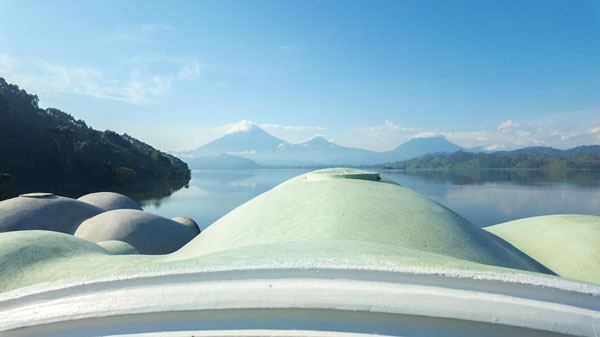 Some of the amazing artwork at Kisoro Art Island.
The architectural direction, led by Ugandan architect Alex Musabyi in close collaboration with Ruganzu, is joined by additional narrative layers. A sculptural “Zome” structure designed by Congolese refugee architect Patrick Muvunga introduces geometric experimentation and regional displacement narratives into the island’s spatial vocabulary.
Meanwhile, A-frame “art frames” double as artist residency studios, deliberately placed to encourage interaction between creators and guests. The effect is a porous boundary between living space and studio space, where artistic process is never fully hidden from experience.
The island as a living collection
If the architecture forms the island’s skeleton, the art collection provides its pulse. Kisoro Art Island is conceived as a permanent, curated environment of site-specific and international works. Among the featured artists is Sanaa Gateja, the Kisoro-born pioneer who has represented Uganda at the Venice Biennale. His signature material language—paper beads and textile assemblage—brings a philosophy of healing through making, transforming fragile materials into dense symbolic systems of renewal.
From Ghana, multidisciplinary artist Samuel Kortey Baah extends the collection’s regional dialogue, while U.S. artist Shrine contributes one of the island’s most physically commanding installations: two 16-foot ziggurat towers titled Rituals of Peace. Constructed during a 30-day residency using stone, mortar, glass bottles, and plastic waste, the towers stand as both monument and critique—transforming discarded material into architectural ritual objects that speak to environmental repair.
Elsewhere, installations invite more intimate engagement. Sserunjogi Wilberforce’s Kazindalo functions as a symbolic funnel, designed as a psychological passage through which visitors metaphorically shed burdens before entering a state of renewal.
Even movement across the island becomes aestheticized. Boats are hand-painted as floating canvases, transforming transport into mobile gallery space. At the most immersive edge of the experience, a floating bed installation allows guests to recline directly on Lake Mutanda, suspended between water, sky, and volcanic horizon.
Beyond the island, Kisoro Art Island extends into some of East Africa’s most protected wilderness corridors. Guests are offered guided gorilla trekking experiences into Bwindi Impenetrable Forest and Mgahinga Gorilla National Park, both UNESCO-listed sites and home to the endangered mountain gorilla.
These encounters are carefully structured around conservation ethics and controlled access. Groups are limited to ten visitors, ensuring minimal ecological disruption. The treks themselves move through high-altitude terrain—often exceeding 2,000 metres—demanding both physical endurance and attentiveness to the forest environment.
Guides, many from generational ranger families, carry inherited knowledge of the landscape, transforming each trek into both ecological education and cultural transmission. Even accessibility is reimagined through local ingenuity. For guests unable to undertake the full trek, a traditional sedan-chair system—affectionately referred to as the “African Helicopter”—extends access into difficult terrain, blending practicality with cultural humour.
Throughout, strict conservation protocols, including mask use near gorillas, reinforce the fragile balance between tourism and habitat protection.
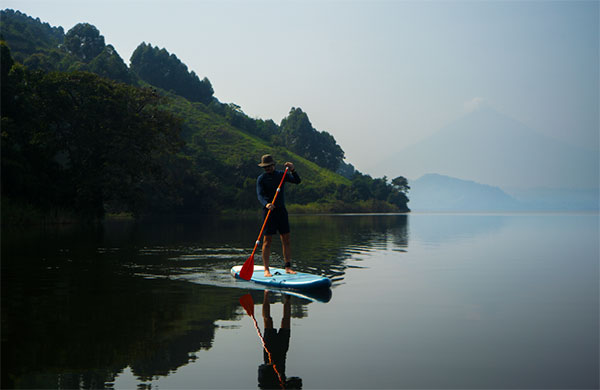 A guest of Kisoro Art Island paddles a boat on Lake Mutanda.
Art as an economic infrastructure
While Kisoro Art Island presents itself visually as a retreat, its underlying logic is infrastructural. It is explicitly designed as a model for economic redistribution through cultural tourism. The project draws inspiration from international precedents such as Naoshima in Japan and Bilbao in Spain, where art-led development reshaped entire regional economies. In Kisoro, however, the ambition is more community-embedded than monumental.
Approximately 90% of staff are recruited from surrounding villages, embedding income streams directly into local households. A percentage of revenue from experiences such as gorilla trekking is allocated to conservation and community projects, reinforcing a circular economic model where tourism funds the preservation of the very ecosystems it depends on.
Education is a central pillar. The island supports a local primary school in Kisoro and provides scholarships for continued study beyond secondary education. Future plans include a health clinic intended to serve both residents and visitors, further blurring the boundary between hospitality and public infrastructure.
The intention, as articulated by the founders, is not extraction but continuity—an ecosystem where cultural production, environmental stewardship, and social development reinforce each other.
The philosophy behind the island
Kisoro Art Island is co-founded by Bruno Ruganzu and urban placemaker Mike Zuckerman, with philanthropic backing from the Sijbrandij Foundation. But its conceptual core is deeply tied to Bruno’s broader artistic philosophy.
A practitioner of what has been described as eco-constructivism, Bruno’s work transforms waste materials into large-scale social sculptures. His practice is grounded in the belief that discarded matter contains cultural memory—and that through transformation, it can be reinserted into systems of value.
Educated in Uganda and Norway, and currently a PhD candidate in Design and Visual Culture, Bruno has long operated at the intersection of academia, activism, and art-making. His work draws heavily on the philosophy of Ubuntu, the idea that identity is formed through community rather than isolation.
At Kisoro Art Island, this philosophy becomes spatial. Art is no longer an object to be viewed but a condition of participation. Guests are not simply visitors; they are embedded within an evolving cultural system shaped by artists, villagers, landscapes, and materials in constant dialogue.
Kisoro Art Island ultimately resists easy categorization. It is neither purely resort nor museum, neither a conservation project nor an art installation. Instead, it operates as a hybrid system—one that treats geography as material, culture as infrastructure, and hospitality as a form of artistic practice.
In doing so, it proposes a subtle but significant shift in how cultural development might function in East Africa. Rather than importing models of tourism or museum-making, it builds outward from local materials, local histories, and local labour—then extends them into global artistic networks.