


For investors and analysts, the latest results underline a shifting competitive dynamic
NEWS ANALYSIS | THE INDEPENDENT | Equity Group Holdings Plc has extended its lead over rival KCB Group Plc after reporting a sharp rise in annual profits, underscoring how regional diversification and digital banking are redrawing the competitive landscape in East Africa.
Equity said net profit for the year to December rose 55 per cent to Ksh75.5bn (Ush2.11 trillion) the highest on record for a Kenyan company. The performance places it ahead of KCB, which posted an 11 per cent increase in profit to Ksh68.4bn (Ush 1.9 trillion) over the same period, highlighting a widening gap between the two lenders.
The contrasting growth rates point to differing strategic emphases. Equity has leaned heavily into regional expansion and technology-driven efficiencies, while KCB has prioritised balance sheet strength, capital resilience and steady returns.
Equity’s total assets rose 9 per cent to Ksh1.97tn (Ush55.2 trillion), with customer deposits increasing to Ksh1.46tn (Ush 40.9 trillion). Its loan book expanded to Ksh882.5bn (Ush 24.7 trillion), supported by demand across its core markets. KCB remains the larger bank by assets, with a balance sheet of Ksh2.15tn (Ush 60.2 trillion) and a loan book of Ksh1.59tn (Ush 44.5trillion), reflecting its continued dominance in terms of scale.
Revenue growth at the two banks was broadly comparable. Equity reported a 12 per cent increase in total income to KSh217.7bn (Ush6.1 trillion), marginally ahead of KCB’s Ksh214bn (Ush 607.6 billion). However, Equity’s stronger profit growth was underpinned by a marked improvement in efficiency, with its cost-to-income ratio falling to 51 per cent from 58.2 per cent.
KCB, by contrast, maintained a lower cost base, reducing its cost-to-income ratio to 42.5 per cent, suggesting tighter operational control despite a more modest pace of earnings expansion.
A key differentiator has been Equity’s rapid shift towards digital banking. The group said more than 98 per cent of transactions are now conducted outside branches, with 88.4 per cent processed through digital channels. The move has helped lower operating costs while increasing transaction volumes.
KCB has also invested in digital platforms, with non-funded income accounting for 31 per cent of total revenues, but its transformation has been less pronounced than Equity’s in terms of transaction migration.
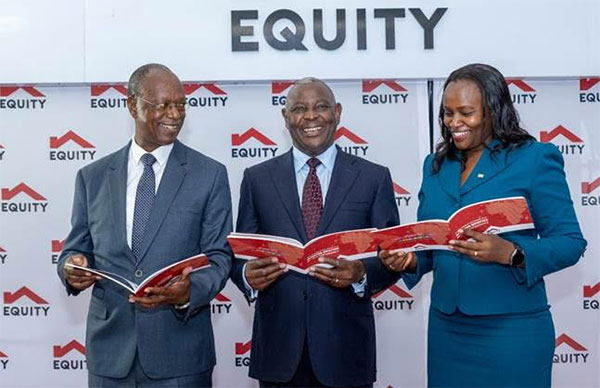 From L-R: Equity Group Chairman, Prof. Isaac Macharia, Group Managing Director and CEO, Dr. James Mwangi and Director Equity Group Foundation Operations, Dr. Joanne Korir, during the FY 2025 Investor Briefing event recently.
The growing contribution from regional subsidiaries is another area where the two banks diverge. Equity said operations outside Kenya now account for roughly half of its profits, driven by strong performances in markets such as the Democratic Republic of Congo, where earnings rose 58 per cent.
Subsidiaries record huge growth
In Uganda, profit increased fivefold to Ksh3.6bn (Ush 100.8 billion), while Rwanda and Tanzania also delivered steady growth.
KCB’s regional businesses – Uganda, Tanzania, Rwanda, DRC, Burundi and South Sudan – contributed about 30.7 per cent of profit before tax, indicating progress in diversification but also a continued reliance on its Kenyan operations.
From a risk perspective, both lenders showed signs of improving asset quality. Equity reduced loan loss provisions by 28 per cent and strengthened its coverage ratios, while KCB lowered its non-performing loan ratio to 16.9 per cent from 19.2 per cent, supported by recoveries and balance sheet restructuring.
KCB also retained a strong capital position, with core capital at 18.4 per cent of risk-weighted assets and liquidity well above regulatory thresholds — a factor likely to reassure regulators and conservative investors.
Shareholder returns reflect the differing profiles of the two institutions. Equity proposed a dividend of Ksh5.75 (Ush 161) per share, amounting to Ksh21.7bn (Ush 607.6 billion), a sharp increase from the previous year. KCB announced a total dividend of KSh7 per share (Ush 196), with a combined payout of Ksh22bn (Ush 616 billion), signalling a commitment to consistent distributions.
Returns on equity remain robust at both banks. KCB reported a group return on equity of 22.5 per cent, while Equity’s Kenyan unit delivered 26.8 per cent, pointing to strong profitability at the core business level.
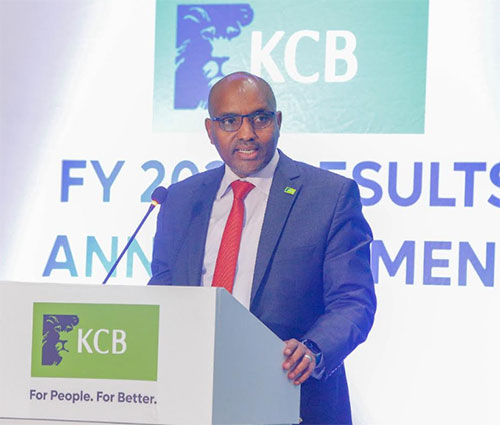 At KCB, Chief Executive Officer, Paul Russo,
Chief executive Officer, James Mwangi, said Equity’s performance reflected the success of its transition into a regional financial services group, with diversification helping to cushion against volatility in individual markets.
At KCB, Chief Executive Officer, Paul Russo, emphasised disciplined execution and a focus on sustainable growth, noting that the bank continued to support key sectors of the economy despite a challenging operating environment.
The broader macroeconomic backdrop has been supportive. Several African economies, including Uganda and Rwanda, are among the fastest growing globally, while commodity exports in countries such as the Democratic Republic of Congo have bolstered economic activity.
Even so, banks remain exposed to external risks, including geopolitical tensions and commodity price volatility, which could affect inflation and interest rate trajectories.
Outlook
Looking ahead, Equity is pursuing an ambitious expansion strategy aimed at reaching 100m customers across 15 markets by 2030, supported by investments in digital infrastructure and artificial intelligence.
KCB, meanwhile, is focusing on deepening its regional presence, strengthening its capital base and expanding its digital ecosystem, including investments in payments and fintech platforms.
The two banks are eyeing entry into the Ethiopian market this year through the acquisition of a stake in a local financial institution.
For investors and analysts, the latest results underline a shifting competitive dynamic. Equity’s faster growth and increasing regional contribution suggest a bank in expansion mode, while KCB’s scale, capital strength and steady returns point to a more conservative but resilient model.
Together, the two lenders illustrate the evolving nature of African banking — where growth, technology and geographic reach are becoming as important as balance sheet size in determining market leadership.
Key figures
Equity vs KCB
Exchange Rate Used: 1 Ksh ≈ 28 Ush
EQUITY GROUP
Profit after tax: Ksh75.5bn → ~Ush 2.11 trillion
Previous profit: Ksh48.8bn → ~Ush 1.37 trillion
Total assets: Ksh1.97tn → ~Ush 55.2 trillion
Customer deposits: Ksh1.46tn → ~Ush 40.9 trillion
Net loans: Ksh882.5bn → ~Ush 24.7 trillion
Total income: Ksh217.7bn → ~Ush 6.1 trillion
Dividend payout: Ksh21.7bn → ~Ush 607.6 billion
Dividend per share: Ksh5.75 → ~Ush161
Regional Performance:
DRC profit: Ksh24.7bn → ~Ush 691.6 billion
Uganda profit: Ksh3.6bn → ~Ush 100.8 billion
Rwanda profit: Ksh5.4bn → ~Ush 151.2 billion
Tanzania profit: Ksh2.7bn → ~Ushs 75.6 billion
KCB GROUP
Profit after tax: Ksh68.4bn → ~Ush1.92 trillion
Total assets: Ksh2.15tn → ~Ush 60.2 trillion
Loan book: Ksh1.59tn → ~Ush 44.5 trillion
Customer deposits: Ksh1.59tn → ~Ush 44.5 trillion
Total revenue: Ksh214bn → ~Ush 6.0 trillion
Dividend payout: Ksh22bn → ~Ush 616 billion
Dividend per share: Ksh7 → ~Ush 196
Summary:
- Equity leads in profitability with over Ush 2 trillion in earnings.
- KCB remains larger by assets, exceeding Ush 60 trillion.
- Both banks return over Ush600 billion to shareholders.
- Regional operations are increasingly significant contributors to growth.

