

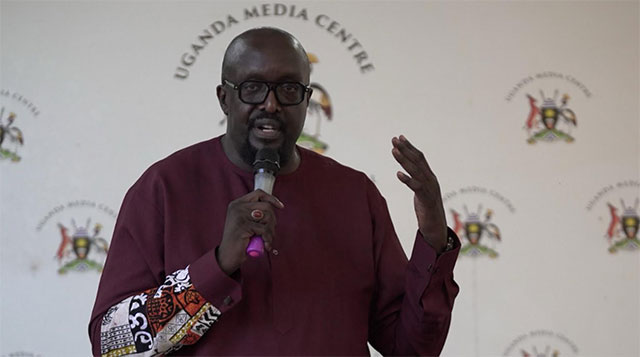
 Alan Kasujja, the new Executive Director of the Uganda Media Centre speaks during his inauguration on March 24 at the Uganda Media Centre in Kampala. COURTESY PHOTO/UGANDA MEDIA CENTRE.
Inside his first moments at the Uganda Media Centre and the deeper crisis of Government’s fractured voice
Kampala, Uganda | RONALD MUSOKE | The rain came first, as it often does in Kampala; sudden, insistent, and cleansing. It fell through the morning of March 24, washing over the city’s red earth, settling the dust and cooling the air. By early afternoon, the clouds had lifted, leaving behind a warm, humid stillness.
“In Africa, when it rains, it is a blessing,” Moses Watasa, the day’s Master of Ceremony who is actually the Commissioner for Information and Communication at the Ministry of ICT and National Guidance, told those gathered at the Uganda Media Centre. “It’s a good omen.”
Chairs had been arranged outside, just beyond the entrance of the Uganda Media Centre; a low, aging 1960s bungalow that, over the years, has been repurposed into the government’s official communications clearing house. The setting carried its own quiet symbolism- a state institution operating from what still felt unmistakably like a converted home.
Before COVID-19, journalists would pack into a small room inside, crowding shoulder to shoulder, recorders raised, cables tangled beneath their feet. But the pandemic had forced them out. Social distancing SOPs moved the briefings into the open air, and even after restrictions eased, the arrangement remained.
It was here, under a sky still heavy with the memory of rain, that Alan Kasujja stepped forward to assume one of the most sensitive roles in government: Executive Director of the Uganda Media Centre. The ceremony began in familiar fashion; formal acknowledgments, carefully structured speeches, and the steady rhythm of official transitions. Then, abruptly, it broke.
Offended by sound quality
“First of all, can I just understand this microphone,” Kasujja said, interrupting the flow. There was a pause. “Where are we getting the sound from?” A few heads turned backwards to the overhead speaker mounted on top of an ironbar structure at one of the front corners of the house.
“What about the rest of the cameras? Where are they getting sound from?” the journalists still pointed to the overhead speaker. “That’s very poor-quality sound. Why are we getting sound from just that head? Why are there no microphones here?” It was less than a minute into his first public appearance in the role. And already, something fundamental had been exposed.
A house carrying the weight of a state
The Uganda Media Centre does not look like the command centre of a modern government. It does not announce itself with scale or spectacle. It sits quietly at the corner of Clement Hill Road; a bungalow from another era, its walls adapted, its spaces improvised, its infrastructure stretched beyond its original purpose.
Yet from this house, the Ugandan government has attempted, for two decades, to coordinate its voice. “This centre is fully functioning. We don’t have debts. You are not taking over a crisis institution. There is nothing to bother you,” said Obed Katureebe, the outgoing acting Executive Director, as he handed over to Kasujja.
But even as he spoke, the limits of that reassurance soon became impossible to ignore. “We have one functioning camera. We don’t have studio equipment. We have only one vehicle. We don’t have (a vehicle) for the ED,” Katureebe continued, his tone matter-of-fact. “So, the staff jump on boda boda (motorcycle taxi) or they use whatever when we are doing field engagement.”
Then came the story that cut through the room. “During the elections (2026 general election) we had hired a van from general service providers. (Most times) you don’t even know how efficient they are… The van rolled off the hills of Kapchorwa (slopes of Mt. Elgon in eastern Uganda) but God is good. None of our staff of the full van got injured,” Katureebe said.
There was a murmur; quiet, unease. A functioning institution, yes but one operating at the edge of its limits. What, perhaps Katureebe was telling Kasujja, was that the Uganda Media Centre might look stable but it is stretched and; it might be trusted, but it is under-resourced. Kasujja had not needed the full briefing document in a yellow folder to grasp this reality. He had already encountered it, in the microphones.
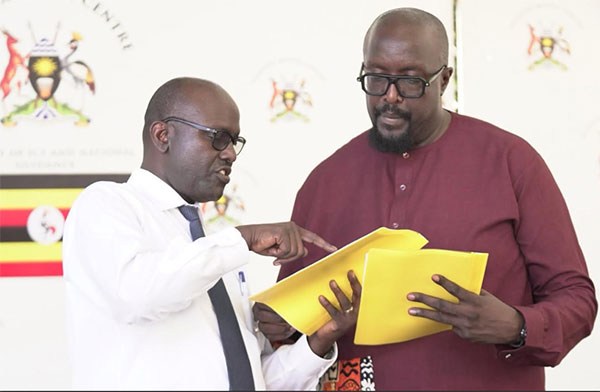 Obed Katureebe, the outgoing acting Executive Director (left) hands over status reports to Alan Kasujja during the inauguration ceremony at the Uganda Media Centre. COURTESY PHOTO/UGANDA MEDIA CENTRE.
A reputation returns, with expectations attached
Kasujja does not arrive as a technocrat. He arrives with a reputation. For more than a decade, his voice traveled across continents through the BBC, where he served as a lead presenter on Newsday and also hosted the Africa Daily podcast. His work helped frame African narratives for a global audience; measured, analytical, and grounded in context.
Before his stint on the BBC, he had been a defining voice within Uganda itself, hosting The Big Breakfast on Capital FM, anchoring The Fourth Estate on local broadcaster NTVU, and co-moderating the country’s first televised presidential debate in 2016.
Now, appointed by President Yoweri Museveni to replace long serving Ofwono Opondo, he returns not to interrogate power, but to articulate it. “This is not just a mere change of guards; this is a fundamental change,” he said, perhaps borrowing from his appointee’s famous inauguration speech delivered on the steps of Parliament in 1986.
“I want to give thanks to His Excellency the President for this opportunity to serve my country, the country that gives me my identity, the country that I love with all my heart, and I am going to serve this country with integrity, dedication and purpose,” he said. “We are going to build on what has already been built and we are going to turn what is already in place here into an even more efficient and better machinery to speak for this country.”
“It’s not business as usual, if for nothing else then because Uganda is at an inflexion point, and the story we tell about our country and how we tell the story will shape the decade ahead.”
Kasujja said Uganda has ambitions; pointing to the government’s tenfold economic growth strategy which seeks to grow the country’s GDP by ten times, from the current US$50bn GDP to about US$500bn by 2040. To get there, the government has earmarked four sectors; agro-industrialisation, tourism, mineral development, science and technology, and innovation, to propel the economy.
Kasujja said it is a “real bold, audacious ambition, but one that is achievable, and one that is also time-sensitive.”
“A vision this powerful demands communication that is equally powerful. So, citizens in this country from Moroto to Kiryandongo to Kisoro must understand and believe in this plan,” he said.
He paused, then sharpened the point. “This is not a PR exercise. Government communication is not a PR exercise. It is nation building, and this has to be taken very seriously.”
“My appeal to whoever is responsible for giving us money as the Uganda Media Centre, let us stop playing games,” Kasujja said, turning his head in the direction of Dr Aminah Zawedde (PhD), the Permanent Secretary at the Ministry of ICT and National Guidance, under which the Uganda Media Centre falls.
A landscape that has outpaced its architects
Yet, the challenge before Kasujja is not simply institutional, it is also structural. When President Yoweri Museveni came to power in 1986, Uganda’s communication and media environment was narrow and manageable. There was only Radio Uganda and Uganda Television and a limited print ecosystem.
Today, the landscape is almost unrecognizable. There are hundreds of FM stations (283 as at 30 September 2024) and dozens of television channels (65 as at 30 September 2024) licenced to operate across Uganda. There is also a digital ecosystem where millions of Ugandans engage daily; on WhatsApp, TikTok, YouTube, Instagram, and X social media platforms.
“By the time you listen to what we are saying… social media will have broadcast whatever has happened here,” said ICT Minister Chris Baryomunsi during Kasujja’s inauguration. “So maybe what you will publish tomorrow… may not be news.” What Baryomunsi was saying is that information no longer flows in sequence; it erupts and in that eruption, control becomes elusive.
Fragmentation at the heart of government
Kasujja’s central concern is not the volume of communication, but its fragmentation. “We want to see a government that speaks with one voice,” he said. “Because fragmented messaging is not just inefficient, but it also erodes public trust.”
But the current structure of government communication makes that goal difficult. Every ministry, department, and agency has its own spokesperson. Uganda’s 146 districts communicate with local populations while the country’s embassies and missions engage international audiences. Each node generates its own messaging; sometimes aligned, sometimes not.
“We have competing voices from different MDAs that hurt the credibility of the government, and that is an issue that we are going to address, and our immediate priority is going to make sure that we streamline and unify government communication across ministries, departments, and agencies,” Kasujja said.
“In addition, we are going to establish a coherent, coordinated national narrative. One voice is not about uniformity, it’s about coherence, being heard, being understood. It’s about trust. It’s about impact. And when the government speaks with clarity, we all know that citizens will respond with confidence.”
“We are going to convene stakeholder forums to reach out to people. We want to upskill government communication offices, and I’m glad that the Permanent Secretary is aligned on this one and is very supportive,” Kasujja added.
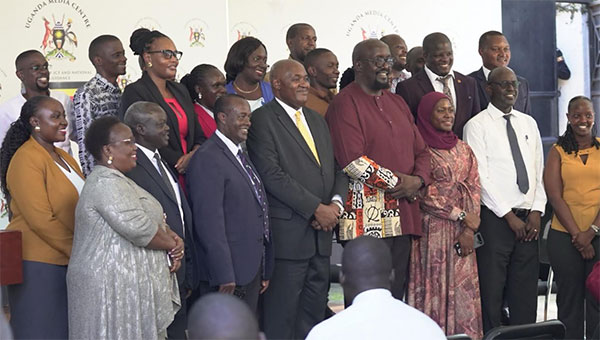 Alan Kasujja flanked by Dr Chris Baryomunsi, the Minister of ICT and National Guidance (left) and Dr Aminah Zawedde (PhD), the Permanent Secretary at the Ministry of ICT and National Guidance (right) pose for a group photo with staff of the Uganda Media Centre and the Ministry of ICT and National Guidance. COURTESY PHOTO/UGANDA MEDIA CENTRE.
The parallel voice of power
But, Kasujja will perhaps soon discover, if he already does not know, that the problem is not just multiplicity, it is also about the inconsistency of govetrnment actors. Complicating matters further is the presence of influential voices that operate outside formal communication channels. Foremost among them is his bosom buddy, Gen. Muhoozi Kainerugaba, the Chief of Defence Forces and the president’s son whose statements carry significant weight.
On social media, particularly on the X platform, he has developed a direct and often controversial style, commenting on political developments within Uganda and beyond. He does not wait for coordination. He does not always align. And that has sometimes created tension.
In early 2026, a public disagreement emerged between him and ICT Minister Chris Baryomunsi, who is/has been the official government spokesperson. The minister made it clear that some of the general’s posts did not reflect official government positions and were complicating communication efforts. The episode exposed a deeper truth: power in Uganda does not speak from a single channel. For Kasujja, tasked with creating coherence, this is not a side challenge, it is central.
Between control and the speed of the crowd
The Permanent Secretary, Aminah Zawedde, framed the challenge with quiet precision. “News breaks quickly on social media, and public perception forms just as fast,” she said. “Today we are not dealing with only public, traditional communication… we are dealing with communication that is emerging and evolving.” She went further. “Communication does not only stop at government side… it is also communication for the whole country.” The implication is clear.
The state no longer owns the narrative. It participates in it. For decades, President Museveni operated within a system where communication could be structured, disciplined, and controlled. But digital platforms have introduced velocity; and with it, unpredictability. Kasujja’s task is not simply to restore order, it is to operate within disorder.
Kasujja’s vision is expansive, almost audacious. “We want to make the Uganda Media Centre the most efficiently run government communication service on the continent,” he said. He spoke of digital transformation, real-time engagement, professionalization, and strategic partnerships. But his tone shifted when he addressed resources. “Let us stop playing games,” he said. “We need money. We don’t want to be begging you for money. We need this money so that we can do the work we are supposed to do,” he said.
It was a rare moment of bluntness. He continued: “We need modern tools; we need modern infrastructure. I can’t walk into a place like this and find one camera… no microphones… and we have to borrow and hire.” The gap between ambition and capacity was no longer abstract, it was visible and audible for anyone to see.
Trust, credibility, and the cost of inconsistency
“The Uganda Media Centre has believability,” Katureebe had earlier reassured his successor. “People believe in UMC.” That credibility has been built over years; through consistency, through presence, through the perception of reliability. But in a fragmented communication environment, trust becomes harder to sustain.
Conflicting messages may weaken authority and delays in government response invite speculation while parallel voices create ambiguity. Kasujja understands this instinctively. “One voice is not about uniformity,” he said. “It’s about coherence… it’s about trust. It’s about impact.” But coherence, in this context, is not simply a technical goal. It is a political one.
As the ceremony drew to a close, the atmosphere softened. The formalities gave way to informal exchanges; handshakes, quiet conversations, small bursts of laughter. Then came the final gesture: a cake, brought forward and cut to mark the beginning of Kasujja’s tenure.
It was a familiar ritual. A symbolic sweetness to close an afternoon that had begun with rain and sharpened into realism. Yet, even as slices of cake were shared, the earlier moment lingered. The question about the microphones. Alan Kasujja had revealed something essential, not just about the Uganda Media Centre, but about the state of government communication itself.
Before strategy, there must be structure and before narrative, there must be clarity. Before unity, there must be alignment and before all of that, there must be the basic ability to be heard. “We go to work now,” Kasujja had said in his concluding remarks. It sounded like a conclusion but in reality, it was just the beginning.