

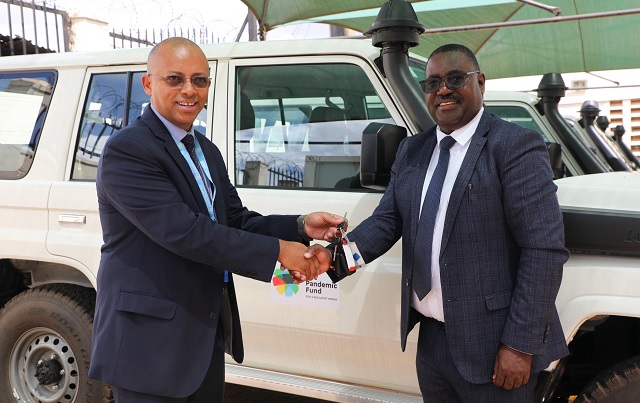
 Ezana Kassa, FAO Representative in Uganda(left) and Dr. Andrew G. Seguya, Executive Secretary of GVTC (right)
Kampala, Uganda | THE INDEPENDENT | In one of Africa’s most epidemiologically sensitive ecosystems, the gap between detection and response remains a defining vulnerability. The Greater Virunga Landscape where humans, livestock, and wildlife interact daily has long been identified as a potential hotspot for zoonotic spillovers, with implications that extend far beyond national borders.
A new intervention by the Food and Agriculture Organization of the United Nations (FAO) is now targeting that gap, with the handover of eight field vehicles to frontline actors as part of a broader effort to strengthen early warning systems and outbreak response.
The vehicles, delivered to the Greater Virunga Transboundary Collaboration (GVTC) and Gorilla Doctors, are funded under the World Bank’s Pandemic Fund and implemented jointly with the World Health Organization (WHO) and UNICEF. The initiative is anchored in the One Health approach, which integrates human, animal, and environmental health systems in managing disease risk.
For health experts, the intervention speaks to a larger shift in global health strategy from reactive outbreak control to proactive surveillance at source. In regions like Virunga, where mobility constraints have historically slowed field response, logistics often determine outcomes.
“This handover comes at a critical moment,” said Dr. Andrew G. Seguya, Executive Secretary of GVTC.
“It strengthens our operational capacity and our ability to respond effectively to zoonotic disease threats, while reinforcing collaboration across borders under the One Health approach.”
The scale of the surveillance effort is already expanding. More than 3,000 samples have been collected across the landscape, reflecting growing system reach, but also underscoring the complexity of monitoring a region defined by porous borders and ecological overlap.
From a public health perspective, timeliness remains the central metric. Delayed detection particularly in remote or underserved areas—continues to be a key driver of outbreak escalation.
Dr Edson Katushabe, Resilient Systems and Readiness Officer at WHO, said the additional field support will improve the timeliness and efficiency of surveillance and response activities, particularly in underserved areas.
The intervention also aligns with a broader push to strengthen “last-mile” health systems ensuring that surveillance infrastructure extends to communities where risk is highest and access is weakest.
Speaking on behalf of UNICEF, Stefan Lawson, Chief of Health, emphasized that the vehicles will help extend services to the last miles, supporting surveillance, early warning systems, and rapid response in communities most at risk.
The Virunga landscape presents a uniquely complex health environment. Its biodiversity while globally significant creates constant interfaces between species, increasing the probability of pathogen transmission. For conservation organisations working in the region, health security has become inseparable from ecosystem management.
Partners including WWF, Gorilla Doctors, the International Gorilla Conservation Programme (IGCP), and the International Union for Conservation of Nature (IUCN) have welcomed the support, pointing to the need for integrated systems that can manage both conservation and health risks simultaneously.
For FAO, the intervention reflects a preventive logic reducing pandemic risk before it materialises.
“This initiative reflects the One Health approach in action,” said Ezana Kassa, FAO Representative in Uganda.
“By strengthening field operations and coordination, we are helping protect livelihoods, safeguard biodiversity, and reduce the risk of future pandemics across the region.”