

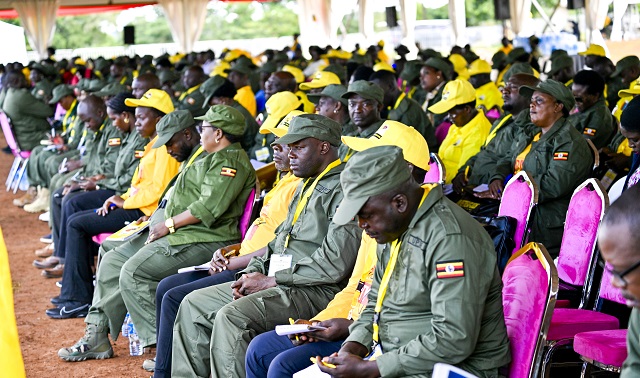
Kyankwanzi, Uganda | THE INDEPENDENT | A lecture at the National Resistance Movement (NRM) retreat in Kyankwanzi has pushed Uganda’s governance model back into focus, recasting what is often treated as a constitutional question into a matter of economic management and market stability.
Prof. Gerald Kagambirwe, addressing party leaders, challenged the rigid application of Western constitutional theory, arguing instead for a pragmatic balance between institutional checks and coordinated leadership. While acknowledging Montesquieu’s principle that “power must check power,” he said the realities of governance require a more flexible approach.
The intervention comes as Uganda leans on state-led investment to drive growth, placing pressure on institutions to deliver both speed and accountability. In that context, the relationship between the Executive and Parliament is increasingly viewed as a key variable in shaping policy outcomes and investor confidence.
Western democracies typically emphasise strict separation of powers. Uganda’s system, however, operates through a more integrated framework in which ministers sit in both the Executive and Parliament. Kagambirwe noted that while “clear separation exists in theory,” political practice reflects institutional overlap.
“There is what is pragmatic, let us do what works. So we have to balance between the legal provisions and the political practice,” he said.
That balance has direct implications for the private sector. The degree of alignment between the Executive and Parliament can determine how quickly legislation is passed, how efficiently infrastructure projects are implemented, and how predictably economic policy is managed.
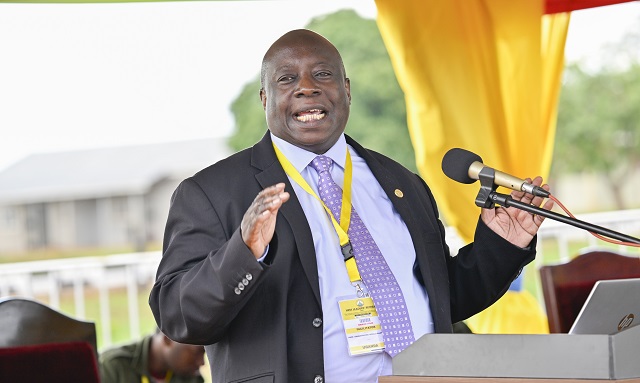 Prof. Gerald Kagambirwe
Kagambirwe situates this model within an Afrocentric governance tradition, where consensus- building and collective responsibility historically shaped decision-making. In contrast to adversarial systems, this approach prioritises coordination, a feature he suggests can reduce political friction and support policy continuity.
For investors, such predictability can act as a stabilising factor. Markets tend to respond negatively to institutional conflict, particularly where it delays major projects or disrupts fiscal planning. A coordinated system, by contrast, can signal policy coherence and reduce uncertainty.
However, the model is not without risk. Greater alignment between institutions can also limit the depth of scrutiny applied to major economic decisions, particularly in areas such as public borrowing.
Kagambirwe pointed to the approval of sovereign loans as a key pressure point. Delays in Parliament can slow project implementation and affect supply chains, but weak oversight raises concerns about rising public debt and its impact on domestic credit conditions.
The issue is becoming more pronounced as Uganda moves toward the 2026/27 financial year, with government balancing infrastructure financing needs against fiscal sustainability.
The broader challenge, Kagambirwe suggested, is maintaining equilibrium. Excessive institutional contestation risks policy paralysis, while excessive conformity can weaken accountability.
For the private sector, the implications are immediate. The governance framework shapes not only the pace of development but also the cost of capital, liquidity conditions, and long-term economic stability.