

By the time a traveller leaves Uganda, there is usually one thing they carry with them.
Not always the lodge. Not always the park. Sometimes not even the place itself.
It is the guide.
The one who kept the conversation going when the road stretched too long. The one who noticed the bird no one else saw. The one who explained why children wave at passing cars, or why a silence in the forest matters. The one who turned what could have been just a trip into something that stayed.
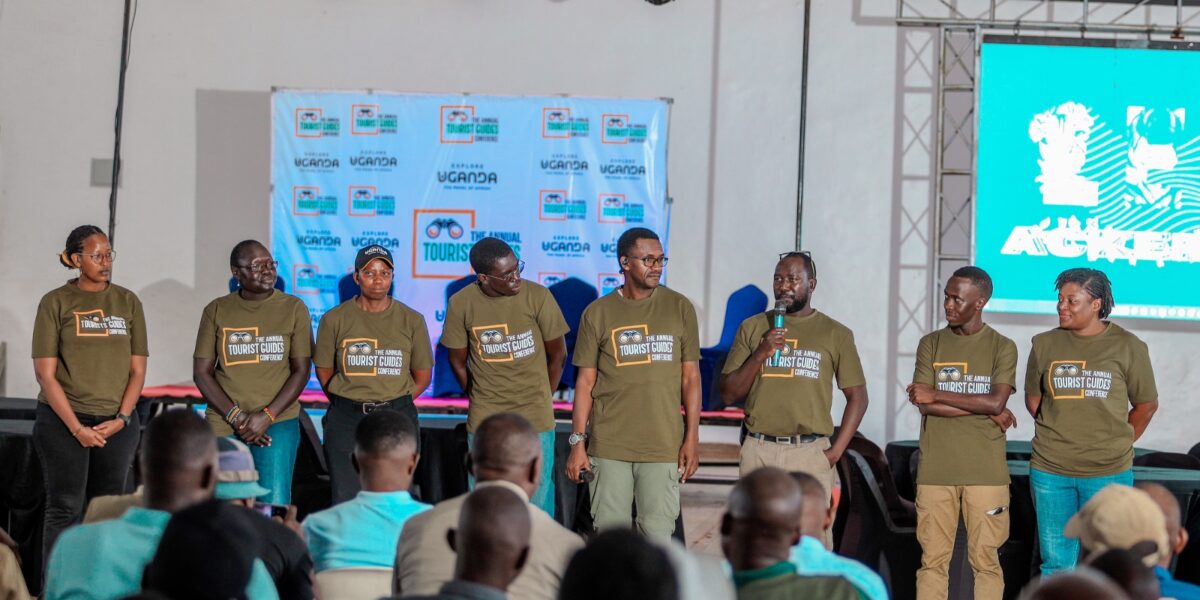
Last Friday and Saturday in Kampala, those people gathered. Not in passing or between trips but deliberately, away from the road, away from the parks, away from the rhythm they are used to.
The inaugural Annual Tourist Guides Conference, started by Johnnie Kamugisha and Peter Mugogo, brought together guides who for years have worked in fragments. One here. Another there. Each building their own way of doing things.
Mugogo says the idea came from something he kept hearing at the end of trips. Travellers would say the same thing, almost casually: the guide was the best part.
At first, it sounded like a compliment. Then it started to feel like a gap.

If that is true, why are guides barely visible in how the industry talks about itself?
Inside the conference hall, the conversations stayed close to the ground.
Guides spoke about the work as it is. Long drives. Reading moods. Knowing when a client is tired but won’t say it. Fixing small problems before they grow.
“You are always thinking for someone else,” one guide said.
Kamugisha returned to a simple point. Guiding is not about how much you know. It is about what you do with what you know.
“You can give facts all day,” he said. “But if someone doesn’t feel anything, it won’t stay.”
Dr. Lilly Ajarova, the conference patron, placed the role of guides in clear terms. They are often the first real connection a visitor has with the country—not at the airport, but on the road, in conversation, in those early moments when impressions are still forming.
If that role is real, she noted, then it needs to be treated as such—through training, standards, and recognition that goes beyond words.

Because much of guiding still depends on individual effort.
Major General Henry Matsiko approached the conversation from another angle. His concern was not just recognition, but position.
If guides are central to the tourism experience, where are they in the decisions that shape it? Where is their voice when policies are written?
Without organisation, he noted, even important work can remain invisible.
In between the sessions, the stories were familiar.
A guide talking about picking up plastic in a park because it didn’t feel right to leave it. Another describing how he spent hours calming a nervous traveller before a trek.
Someone else recalling a client who returned years later, not for the place, but for the person who guided them.
That is the part that rarely gets written down.
By the end of the two days, there was no big declaration. No sweeping resolution.
But something had shifted.
People who usually work alone had sat in the same room and recognised each other’s work.
The organisers say the conference will return next year. That it will grow into something bigger.
For now, the work continues as it always has.
A vehicle pulls up. A guide steps out. A traveller arrives.
And somewhere between the first greeting and the last goodbye, something takes shape that no brochure can fully explain.
That is where the story stays.

