

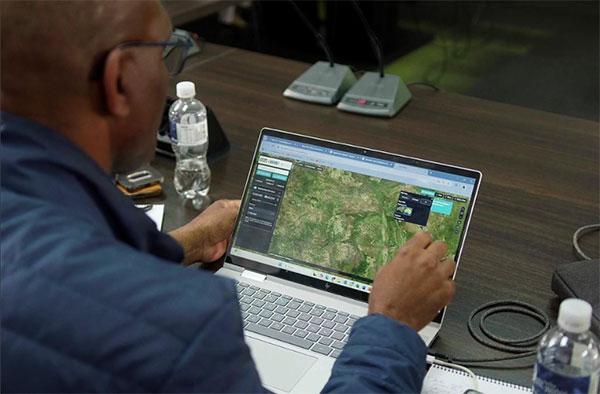
 A researcher studies the satellite imagery of Lake Sulunga ecosystem, in central Tanzania, using the Digital Twin Platform. COURTESY PHOTO/DIGITAL EARTH
New digital tools are revealing the hidden patterns of lakes, rivers and dams, offering Africa a clearer path to water security
NEWS ANALYSIS | RONALD MUSOKE | On the shores of Lake Sulunga in central Tanzania, researcher Nancy Wayua is tracing three decades of change in a water body that has shaped, and sustained, surrounding communities for generations.
Using satellite-derived datasets from Digital Earth Africa, a pan-African initiative that is turning decades of satellite imagery into actionable intelligence for governments, researchers and communities, she maps how the lake’s surface has expanded and contracted between 1990 and 2021, revealing a restless pattern of fluctuation driven by rainfall variability, climate pressure and environmental stress.
What emerges from the data is not just a record of change, but a warning: Lake Sulunga is highly unstable, with analysis showing that only about 44% of its surface remains consistently under water. For communities that depend on it for fishing, watering livestock, salt production and daily survival, those shifts are not abstract, they are lived reality.
It is here, at the intersection of satellite imagery and survival, that a new story about Africa’s water future begins to take shape. From orbit, vast datasets now capture what once remained invisible on the ground; the shifting rhythms of rivers, the shrinking edges of lakes, the strain on dams and wetlands across the continent.
These signals are being transformed into actionable intelligence by Digital Earth Africa, a platform converting Earth observation data into practical tools for water governance at continental scale. As Africa grapples with intensifying scarcity, these insights are becoming central to a broader transformation in how the continent understands and manages its most vital resource.
Water at the centre of Africa’s development future
The urgency of that transformation has been reinforced at the highest political levels. Earlier this year, the 39th Ordinary Session of the Assembly of Heads of State and Government of the African Union in Addis Ababa elevated water to the centre of continental policy by adopting it as the theme for 2026: “Assuring Sustainable Water Availability and Safe Sanitation Systems to Achieve the Goals of Agenda 2063.”
The decision was not just symbolic. It reflected a strategic recalibration of priorities within Africa’s long-term development framework, Agenda 2063, which envisions an integrated, prosperous and peaceful continent driven by its own citizens.
Water now sits at the core of that ambition; not as a supporting service, but as enabling infrastructure for every major development outcome, from industrialisation and food sovereignty to energy expansion and intra-African trade. This shift is echoed in the Africa Water Vision 2063 and Policy report, which reframes water as a strategic asset rather than a basic utility.
In a joint foreword to the report, Senegalese President Bassirou Diomaye Faye and Zambian President Hakainde Hichilema, who are the Chair of the African Ministers’ Council on Water, 2025 – 2027 and Host of the third African Implementation and Partnership Conference on Water, respectively, describe water as the lifeblood of Africa’s development, binding nations together while sustaining economies and ecosystems.
But their message is also cautionary. Climate change, demographic pressure and weak infrastructure are converging into a systemic risk. Without coordinated action, they warn, Africa faces rising costs in the form of drought-driven GDP losses, migration pressures, conflict risks and ecological degradation. Their response is a call for transformation: invest boldly, govern inclusively, innovate relentlessly and act collectively.
A continent under structural pressure
According to the Africa Water Vision 2063 and Policy report, Africa’s water challenge is fundamentally structural. The continent’s population is projected to rise from 1.5 billion in 2024 to more than 2.5 billion by 2050, placing unprecedented pressure on already strained systems. By 2070, it could exceed 3 billion people, roughly triple the population of the early 2000s.
This growth will dramatically reshape water demand. Agriculture already consumes about 75% of freshwater withdrawals across Africa, yet must nearly double output to meet rising food demand. At the same time, energy systems, industrial corridors and rapidly expanding cities are all competing for the same limited resource base.
Africa is also a rapidly urbanising continent and that adds another layer of complexity. Across the continent, cities are expanding faster than water infrastructure can be built or maintained. This is widening inequality in access and increasing exposure to water contamination. The result is a persistent access gap.
In sub-Saharan Africa, only 58% of people have basic water services. The remainder rely on unsafe or unreliable sources, contributing to widespread disease burdens. According to the United Nations World Water Development Report 2026, water-related illnesses linked to poor sanitation continue to claim hundreds of lives daily.
Climate change is intensifying these pressures further; shifting rainfall patterns, lengthening drought cycles and increasing the frequency of extreme floods. Compounding this is the continent’s hydrological geography which shows that 90% of Africa’s surface water is shared across national borders, making water not just a resource issue, but a geopolitical one.
From policy ambition to implementation gaps
Despite strong policy frameworks across most African states, and notable progress in countries such as Ethiopia, Kenya, Namibia and South Africa, implementation remains uneven. The African Development Bank estimates that more than half of African countries still face low levels of coordinated water resource management.
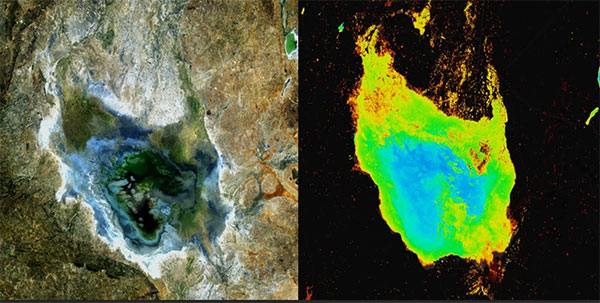 Satellite imagery of Lake Sulunga.
At the heart of this gap lies one critical constraint: data. Water systems are dynamic, but monitoring systems in many countries remain fragmented, underfunded or heavily dependent on infrequent field measurements. This creates blind spots in decision-making, especially in drought-prone or rapidly urbanising regions. Bridging this gap requires a shift from reactive management to predictive intelligence. That is precisely where Digital Earth Africa is reshaping the landscape.
Building a continental water intelligence system
Digital Earth Africa is the world’s largest cloud-native Open Data Cube implementation, designed to turn decades of satellite imagery into analysis-ready information. Unlike traditional datasets that require advanced technical expertise, its tools are pre-processed and standardized for immediate use by governments, researchers and planners.
“Earth observation provides a consistent and comprehensive view of Earth systems; including water bodies such as lakes, reservoirs, wetlands and rivers, and reveals how they change over time,” says Mpho Sadiki, Earth Observation Scientist and Technical Lead at Digital Earth Africa. “This enables decision-makers to access accurate, timely insights for more effective water resource management.”
The platform’s services include Water Observations from Space (WOfS), which tracks the presence and seasonal dynamics of water bodies; a Waterbodies Monitoring Service that analyses 40 years of surface water change; and a Water Quality Monitoring Service that detects turbidity, temperature variation and algal blooms. A wetlands workflow complements these tools, enabling countries to build national inventories and improve ecosystem protection.
These systems are not static dashboards; they are evolving infrastructure for decision-making. They allow governments to track water changes weekly, compare decades of trends and integrate water intelligence directly into planning frameworks.
From basin modelling to real-world decisions
In the Limpopo River Basin, for example, this shift is already visible. Researchers from the International Water Management Institute are working with Digital Earth Africa to improve dam management through satellite data and machine learning models. At Loskop Dam, water volumes are estimated using a combination of satellite imagery, hydrological modelling and reservoir geometry—producing faster and more reliable data than traditional ground-based measurement systems.
These innovations feed into the Limpopo Digital Twin, a virtual representation of the entire river basin used to simulate hydrological scenarios, assess risks and guide operational decisions. Such systems are increasingly vital in a context where climate variability is no longer an exception but a defining feature of water management.
While the innovative work in the Limpopo River basin showcases the transformative potential of DE Africa for large-scale, multi-stakeholder projects, the platform is designed to be accessible and valuable for anyone interested in Africa’s social, environmental, or economic challenges. “DE Africa simplifies complex data into analysis-ready formats tailored for the African context, requiring minimal technical expertise to use,” says Mpho Sadiki.
“This approach ensures that users – from national agencies and research institutions to local planners and individual researchers – can easily leverage earth observation tools to make informed decisions and drive meaningful change.”
The value of satellite intelligence becomes most visible at local scale. In Lake Sulunga, Nancy Wayua’s analysis translates continental data systems into grounded environmental understanding. Her findings show not only long-term variability but also the fragility of systems that communities depend on for survival.
Fishing cycles, grazing patterns and local trade all shift in response to water fluctuations that are now clearly mapped through satellite records. By turning three decades of environmental change into usable intelligence, her work helps bridge the divide between observation and action—giving policymakers and communities a clearer basis for adaptation.
A defining moment for water security
Africa now stands at a turning point. The elevation of water as the 2026 theme by the African Union signals a recognition that water security is no longer a technical issue at the margins of development policy; it is the foundation upon which economic transformation depends.
The Africa Water Vision 2063 provides the strategic framework. Digital Earth Africa provides the technical infrastructure. Researchers like Nancy Wayua demonstrate the applied value at community level. But the challenge remains immense.
Closing Africa’s water gap will require more than technology. It will demand sustained investment, stronger institutions, cross-border cooperation and inclusive governance that brings women, youth and local communities into decision-making processes.
In the end, Africa’s water future will not be determined by scarcity alone. It will be shaped by how effectively the continent turns information into action, and whether it can align political will, scientific innovation and community resilience at scale, because increasingly, the future of water in Africa is not only written in rivers and rainfall. It is also written in data, from outer space.

