

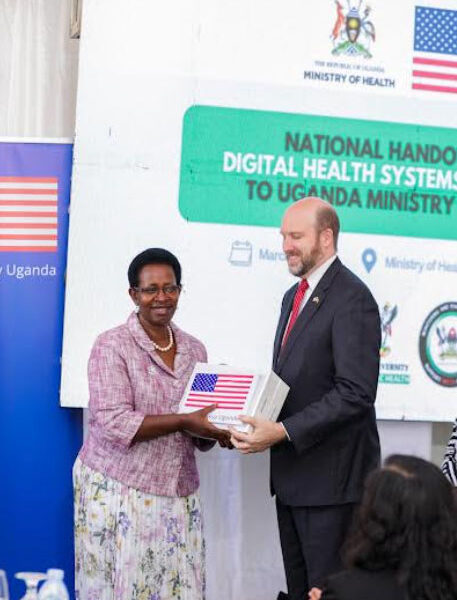
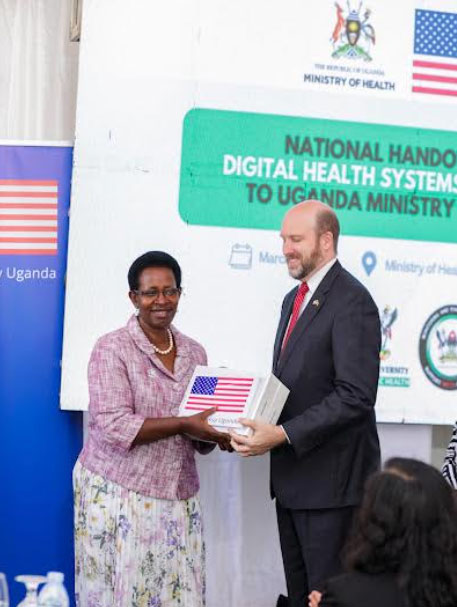
 The Ministry of Health has symbolically received National digital Health Systems, Platforms and tools developed under the 15-year MaKSPH-METS Programme. Ambassador of USA to Uganda HE. William W.Popp, handed it to Permanent Secretary Ministry of Health Dr. Diana Atwine. COURTESY PHOTO
After years of U.S-backed investment, the transfer of data systems marks a shift from external support to state control
COVER STORY | RONALD MUSOKE | In a district hospital in eastern Uganda, a mother waits as a clinician opens an electronic medical records system instead of reaching for a paper file. Within seconds, her child’s clinical history appears on screen: previous visits, diagnoses, and even a laboratory result from another facility weeks earlier.
There is no rummaging through shelves, no delay while records are retrieved, no pause between decision and action. A test is ordered digitally, processed in the laboratory, and returned within minutes. Treatment follows immediately. By the time the consultation ends, the encounter is already logged in the national health data system -s tructured, searchable, and accessible beyond the walls of the district hospital.
This scene is the vision behind Uganda’s digital health transformation programme, known as the Monitoring and Evaluation Technical Support (METS) initiative -a US-funded partnership led by Makerere University School of Public Health.
Designed over a decade ago to strengthen Uganda’s health systems, particularly in HIV and tuberculosis care, it imagines a future where fragmented paper records give way to real-time, interconnected data. Indeed, over the past 15 years, that vision has steadily taken shape. Health data systems have been built, expanded and integrated. Surveillance networks have been reinforced. Electronic medical records have spread across the country, supported by a growing workforce trained in data use and system management.
Now, those systems and the responsibility for sustaining them, have been formally transferred to the Ministry of Health. The scale of the assets is considerable: more than 700 servers, over 4,700 computing devices, solar power installations at hundreds of facilities, and network connectivity spanning more than 1,300 sites. Together, they support a suite of digital platforms underpinning clinical care, surveillance and reporting.
U.S hands over digital health system
Yet, what is changing is not only infrastructure, but ownership. At the Ministry’s headquarters in Kampala on 31 March, the handover ceremony was formal and measured. Speeches were delivered, and partners were acknowledged , but the significance lay beyond the proceedings.
“This handover is not only a physical transfer, but also marks a new phase in national ownership and sustained self-reliance, as the Ministry of Health assumes full responsibility for these systems,” said William W. Popp, the US Ambassador to Uganda.
He noted that while the METS programme has strengthened Uganda’s HIV response and modernised national health information systems, its impact has been broader; supporting emergency response capacity, integrating disease surveillance, improving infection prevention and control, and helping to build a skilled health workforce. These gains, he added, were evident during the country’s response to COVID-19.
“It’s not only been HIV and AIDS that have seen progress in prevention, but so many other health challenges as well, and over the last 15 years, through this programme, we have expanded together digital health reporting nationwide and expanded and strengthened the use of data in decision-making.”
This impact, he explained, has been significant, particularly in disease surveillance systems that can now detect health trends earlier and track deaths more accurately. “This strengthens, of course, Uganda’s ability to manage public health threats and supports broader global health security for the entire world,” he said.
 Dr. Mary Boyd, the CDC Country Director in Uganda (2nd right) hands over an assortment of items to Amb. Popp who, in turn hands them over to Dr. Diana Atwine, the Permanent Secretary at the Ministry of Health (behind lady in dark suit), during the handover ceremony at the Ministry of Health headquarters in Kampala on March 31. COURTESY PHOTO/MAKERERE UNIVERSITY SCHOOL OF PUBLIC HEALTH.
From emergency response to system building
Uganda’s digital health transformation cannot be understood without revisiting its origins in the early 2000s, when the country was at the forefront of the global fight against HIV/AIDS. At the time, systems were built rapidly to respond to an emergency. Data collection was often paper-based. Reporting structures were fragmented and multiple partners operated parallel systems to meet urgent programme needs.
Dr. Diana Atwine, the Permanent Secretary at the Ministry of Health who represented Dr. Jane Ruth Aceng, the Minister of Health, during the handover, remembers that period vividly. “I was in HIV care and the piles of paper that we used to have… huge, huge amounts of paper of patients, especially in chronic care like in HIV. It was a daunting task,” she said.
Her recollection is not nostalgic; it is diagnostic. The problem was not effort, it was visibility. Information existed, but it was slow, fragmented, and difficult to use for decision-making. “I remember when we were going to start PEPFAR… it was like far-fetched,” she said, referring to the U.S. President’s Emergency Plan for AIDS Relief launched under President George W. Bush’s administration. Yet, what began as an emergency response would, over time, evolve into something more structural. “All this is because there was that connection and that collaboration remained and it grew,” Dr. Atwine said.
The METS programme: Designing for the long term
In 2010, the Monitoring and Evaluation Technical Support (METS) programme, implemented by Makerere University School of Public Health, was established to address precisely these systemic gaps.
Its focus was not limited to technology. It targeted the architecture of the health system itself: data governance, monitoring and evaluation, surveillance, and institutional capacity. At the time, Uganda faced a familiar set of challenges; fragmented data systems, parallel reporting channels, limited interoperability, weak surveillance responsiveness, and gaps in quality assurance across services.
The response was deliberate. Rather than build new systems outside government structures, the programme embedded itself within them. It worked with the Ministry of Health to develop standards, strengthen governance, and build capacity from the centre to the district level.
Professor Rhoda Wanyenze, the Dean of Makerere University School of Public Health and Principal Investigator of the programme, was clear about the philosophy behind it. “Our team at the school, the METS team, they know how many times I kept saying, this is not our data, this is not our house, this is Ministry of Health. I need to see you seated in the ministry. I need to see you working with the ministry. I need to see the ministry in charge… What we are celebrating today has been our dream for a long time,” she said during the handover ceremony.
The university’s role, she explained, was to innovate and test but not to own the system indefinitely. “For us in the University, we explore, we are looking for innovative, creative ways of doing things. We test them and then we work with the key actors to take them over and scale them up and sustain them,” she said.
The handover, in that sense, was not a departure from the plan. It was its fulfillment.
What was built
Over 15 years and nearly US$104 million (Approx. Shs 388bn) in investment, the programme contributed to a wide-ranging transformation. Health information systems were strengthened and increasingly integrated. A national data warehouse was established and electronic medical records expanded from limited use to broad coverage across facilities. Disease surveillance systems were scaled, including case-based surveillance, HIV recency tracking, and mortality monitoring. Data quality improved while reporting rates rose sharply; from just over half of health facilities reporting consistently in 2020 to nearly all by 2025.
Digital tools extended beyond facilities to communities, with electronic community health systems supporting village health teams. At the same time, infrastructure was deployed: servers, computers, connectivity equipment, and solar power systems to support facilities with limited electricity. Integration efforts linked systems across functions; laboratories, patient records, facility registries, allowing information to move more seamlessly. Yet, even as systems expanded, the programme maintained a broader focus.
 Amb. William Popp poses for a group photo with senior officials from the Ministry of Health and Makerere University School of Public Health during the handover ceremony at the Ministry of Health headquarters. COURTESY PHOTO/MAKERERE UNIVERSITY SCHOOL OF PUBLIC HEALTH.
Beyond technology: Building capacity
For Dr. Alice Namale, the Executive Director of the MakSPH-METS programme, the most important gains were not technological. “We’ve improved regional referral capacity and the district health team capacity to manage programmes through training, governance, leadership, and management,” she said.
That investment translated into stronger oversight and programme management at decentralized levels. “It resulted in improved oversight and management of HIV programmes,” she added. At the same time, service delivery improved.
“We’ve improved the quality of priority health services delivered in the health sector,” she said. “These systems are being leveraged and deployed by other disease programmes, and the lessons learned are not limited to HIV.” The programme, in her view, functions as a platform; one that strengthens the broader health system, not just a single programme area. Its success, she emphasized, depends on partnership. “This has been a very complex programme,” she said. “We had to adapt along the way as the landscape kept changing.”
The cumulative effect of these efforts is visible across Uganda’s health system–but unevenly. Electronic medical records are now widespread, but not yet universal. In some facilities, they have replaced paper systems almost entirely. In others, they operate alongside them. Surveillance systems have strengthened, enabling earlier detection of outbreaks and more accurate tracking of health trends. Reporting has improved significantly.
But challenges persist. Infrastructure gaps remain, particularly in lower-level facilities. Technical expertise varies across districts. Interoperability; linking multiple systems into a seamless whole, continues to require coordination and investment. The transformation is real, but it is still unfolding.
Sovereignty and the politics of data
Within the Ministry of Health, the implications of this shift are profound. “Data is the lifeblood of decision-making, and it provides the raw materials for accountability,” said Dr. Charles Olaro, the Director General of Health Services.
That statement reflects a broader shift; from data as a reporting requirement to data as a governing tool. Decisions on financing, staffing, procurement, and programme design are increasingly informed by data generated within the system itself. In that sense, digital transformation is not just about efficiency. It is about power; who has information, how it is used, and how decisions are made.
U.S-Uganda health cooperation agreement
Across Africa, the narrative of who ultimately controls digital health systems has raised questions about sovereignty following President Donald Trump’s administration’s recent signing of health cooperation agreements with several African countries, including Uganda, where health data sharing clauses have been embedded in the pacts. Who owns the data? Who controls the systems? What happens when systems built with U.S government support become central to national governance?
During the handover ceremony, Amb. Popp noted that the U.S government’s handover of the system is part of a broader five-year, U.S$2.3 billion (Approx. Shs 8.09 trillion) Memorandum of Understanding signed between Uganda and the United States in December 2025.
“As we all know, just a few months ago, we signed a landmark agreement between the United States government and the government of Uganda for the next five years, totaling U.S $2.3 billion of investment that outlines in that memorandum of understanding a comprehensive vision to save lives, to strengthen Uganda’s health systems and to make Uganda, America and the world safer, stronger and more prosperous through this partnership,” Amb. Popp said.
“The MOU marks a shift from parallel systems to Ugandan leadership and to supporting a government-led health delivery, continued funding for frontline health workers, and for essential commodities, while also ensuring accountability and responsible use of U.S. and Ugandan taxpayer resources.”
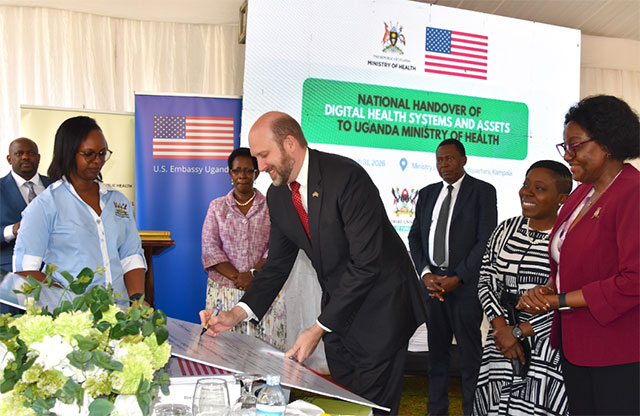 Amb. William W. Popp signs onto a board in a symbolic exercise to show the U.S government’s official handover of digital health systems and assets to the Uganda government at the Ministry of Health headquarters in Kampala on March 31. COURTESY PHOTO/U.S Embassy, Kampala.
The agreement, Amb. Popp said, signals a shift from donor-managed systems to government-led delivery, while maintaining partnership and support. “The transfer of these systems today is a very important step in further increasing Ugandan sovereignty over the health system. We are proud to have been working with Uganda as the United States for what we have accomplished over the last 15 years together,” Amb. Popp added.
“Our goal has been to strengthen local capacity so that Uganda can sustain its progress independently,” he said. The handover, then, is not a withdrawal. It is a transition, one that reflects both trust and expectation.
For Dr. Atwine, the real work begins after the ceremony. The systems now belong to Uganda. Maintaining them will require sustained investment, coordination, and accountability. That includes managing infrastructure, ensuring functionality, and integrating systems into national planning and budgeting processes.
It also means retaining the human capital that made the transformation possible. “You have acquired a lot of skill,” she said, addressing the technical teams who present at the ceremony. “I pray that we don’t lose this important resource.” She described them as “the cream of the cream,” a workforce whose expertise will determine whether the systems continue to function and evolve. At the same time, she was clear about direction. “We are not going back. We are just moving ahead.”
“We have put in place the structure and we are going to discuss further with the ministry responsible for ICT (Ministry of ICT & National Guidance) to make sure that as we transition, as we implement the MOU between the government of Uganda and the U.S. government, we have the structure that we will continue to implement,” Dr Atwine said.
“As you all know, this has been largely a heavily partner funded space…We cannot implement these digital solutions effectively if we do not have the able team that is skilled to continue supporting the districts and our facilities to make sure that we capture data, we utilize data, we analyze data for proper M&E, but most importantly, the data to help us to plan, budget, and implement our programs effectively.”
“The programme also has laid digital health systems, not only at facility but also in the lab. Gone are the days when we used to do the test and then the clinician has to wait for the result, but now the systems are integrated.”
The clinician is in the room and is able to get the information from the lab. We are now also [able to] see the digital system on surveillance. Gone are the days when we used to just wait for the report from the district where someone is calling, but now at a click of a button, we can see the information that comes directly from the low facilities and the districts.
“For us, today is a celebration of these milestones. It is a celebration of growth. It is a celebration of advancement in our healthcare systems. But it is also a celebration of the remarkable collaboration between the U.S. government and the government of Uganda.”
A system still becoming
Across Uganda, the hum of servers is no longer confined to a central data centre. It is distributed; across hospitals, health centres, and districts, where data is increasingly captured, transmitted, and analysed in real time. In some facilities, clinicians rely fully on digital systems. In others, paper files still line the shelves. The transition is uneven, the work is unfinished, but something fundamental has shifted.
What was once a donor-supported programme is now a nationally owned system. And in that shift, from building to sustaining, from support to stewardship, Uganda’s digital health transformation enters its most consequential phase yet.